Showing posts with label buddhism. Show all posts

Tuesday, 17 February 2015

The Rational Basis of Buddhism


The Sleep of Reason brings forth Monsters

The purpose of this blog is to explore how far Buddhism can be supported by rational arguments, both from the philosophical point of view, and also in terms of the observed effects of Buddhist practices.

In other words, if we regard Buddhism as a combination of a philosophy, psychology and religion, then how much mileage can we get from the first two aspects before we have to start invoking religious faith? This is not to say that the religious aspect should be abandoned or disparaged in any way, and I am certainly not advocating the mechanistic reductionism known as 'Secular Buddhism'.

The advantage of  pursuing the philosophical and psychological approaches is that of maintaining a common basis for discussion with science, medicine and Western philosophy for as far as possible, until the paths diverge.


Buddha told us to analyse his teachings.
Of course most religions don't like having their basic tenets subjected to searching analysis, and one cult has abandoned reason altogether, to the extent that you're likely to get your head chopped off for being too rational. 

But Buddhism is different. In the  Kalama Sutra, Buddha said that all religious teachings, including his own should...

(1) Not be believed on the basis of religious authority, or 'holy' books, or family/tribal tradition, or even coercion and intimidation by the mob.

BUT INSTEAD ONE SHOULD

(2) Test the methodology by personal experience. Does it do what it says on the box?

(3) Is the philosophy rational? Or does it require you to believe six impossible things before breakfast?

(4) Judge the tree by its fruits. Is it beneficial, or does it tell you to act against your conscience and 'The Golden Rule'.

According to Geshe Kelsang Gyatso, Buddha told his disciples time and time again not to accept his teachings out of blind faith, but to test them as thoroughly as they would assay gold. It is only on the basis of valid reasons and personal experience that we should accept the teachings of anyone, including Buddha himself.


The advantages of rationalism
One advantage of establishing a rational basis for Buddhism is that it gives  Buddhism an 'intellectual respectability' at a time when the intellectual prestige of other religions is in steep decline, due to increasing obscurantism, which takes variety of forms varying from creationist anti-science to outright terrorism.

This 'intellectual respectability' also may help to prevent Buddhism being hit by collateral damage from increasing prejudice against all religions resulting from jihadist aggression.


Reason versus Revelation
Most religions contain some 'revealed doctrines' or 'dogmas', which were revealed long ago to one person or a few people, and then not to any others.

In all religions other than Buddhism, these ancient, unprovable, unrepeatable revelations are fundamental articles of faith on which the rest of the belief-system is constructed.

In contrast, Buddhism's fundamental doctrines are accessible to reason and investigation in terms of shared, repeatable experience.


The Four Foundations of Buddhism
There are many different schools of Buddhism, but all are built upon the foundations of the Four Seals of Dharma. These Four Seals can be derived from rational analysis.

The four seals are
(i) Lack of inherent existence
(ii) Impermanence
(iii) Unsatisfactoriness
(iv)  Liberation of the mind

The most fundamental of these seals is the first, Lack of Inherent Existence, from which the other three follow logically*.


First Seal -  Lack of inherent existence (emptiness)
No phenomenon is a ‘thing in itself’.  The more you look for it, the less you find it. Things disappear under analysis.  A car exists as a conventional truth, convenient for our everyday lives - a kind of working approximation.  But on dissection, logical analysis can find no ‘essential’ car, just a heap of parts that at a certain arbitrary stage of assembly is designated ‘car’, and at a certain arbitrary stage of disassembly is designated 'pile of junk'.

Outside our mind there is no defining ‘carness’ .  Similarly,  if you gradually decrease the height of the sides of a box until it becomes a tray, there is no point at which 'boxiness' leaves and 'trayfullness' jumps into the structure, with the box being automatically transformed into a tray. It’s all arbitrary mental designation.  This arbitrariness is the ultimate truth of how things exist to our minds. And it goes all the way down to the fundamental particles of matter. 

So how do things exist?
According to Buddhist philosophy, all functioning phenomena are dependently related to other phenomena and their existence arises from three relationships:

(a) Causality: Phenomena exist dependent upon causes and conditions.

(b) Structure: Phenomena depend upon the relationship of whole to parts.

(c) Most profoundly, phenomena depend upon imputation, attribution, or designation by the mind. It's the mind that designates what's a tray and what's a box.

More on Lack of Inherent Existence:    
Sunyata   
Inherent existence   
Reification   
Existence and Impermanence    
Ideal forms and essentialism   
Partless particles


Second Seal -  Impermanence
The impermanence of all functioning phenomena is an inevitable logical consequence of their emptiness of inherent existence.

No functioning phenomenon can be static, because to function it must change and be changed, it must give something of itself or receive something into itself. A truly unchanging phenomenon would reside in splendid isolation and could never even be known to exist. All functioning phenomena are composite and impermanent.  What we term ‘existence’ is really just impermanence in slow-motion.

From  Impermanence, Interdependence & Emptiness
“The ideas of impermanence, interdependence and emptiness are central to Buddhist teaching - and to the whole Buddhist worldview actually.

What these ideas boil down to really is that there is no permanent essence to anything. No part of anything lasts forever or is eternal. Everything (and everyone) that exists does so because of the interrelatedness of various parts - not because it has a permanent essence or "soul" around which all the parts are organized..."

This is true of all things and all people. All things exist interdependently - not as permanent essences. Thus, all things are ultimately "empty" - which is the Buddhist teaching of emptiness.

Because things are empty, they are impermanent. We forget this, says the Buddha, and act as if things are permanent. We desire them to be permanent and when they turn out not to be, we suffer. We suffer especially when we desire permanent happiness from impermanent things or people. It is not possible for impermanent things or people to provide permanent happiness because they themselves are not permanent..."


More on Impermanence:    
Process Philosophy   
Existence and impermanence
Subtle impermanence, the quantum vacuum, radioactive decay and causality


Third Seal -  The Unsatisfactoriness of Material Existence
All emotions based on the three mental poisons of attachment, aversion and ignorance are ultimately painful. You can never have enough worldly possessions, and even if you did you'd worry about losing them since - as stated in the paragraph above - they are all impermanent.  And you've got to lose the lot eventually when you die.

This sense of unsatisfactoriness can range from the severe physical and mental sufferings of people being bombed, burned and raped in war-zones, to the feeling of humiliation suffered by a billionaire who discovers that his business rival has a slightly larger and more luxurious yacht. An object that appeared to be a source of pride and happiness when he bought it, has now turned into a source of shame and aversion.

All materialistic cravings eventually and inevitably lead to disappointment and worse. They cannot provide any ultimate satisfaction.  See  Dukkha, Dawkins, Darwinism and the Selfish Gene  and Symbiotic Mind.


Fourth Seal -  The Ultimate Liberation of the Mind
The first three seals of dharma analysed the factors that imprison our minds in a ceaseless and futile process of chasing after the mirages of impermanent phenomena as if they were permanent,  in the hope of achieving ultimate satisfaction. The fourth seal provides an escape route from this labyrinth of confusion.

The method for liberating the mind from its delusions consists of meditational techniques.   These techniques have been empirically tested and shown to provide psychological benefits in the here and now, though of course Buddhists would also claim that they provide benefits in the hereafter (of which more later).

So as far as clinical assessment is concerned, Buddhist meditation does do what it says on the box.  As Ed Halliwell writes:

"It is not long since just mentioning meditation tagged you as a gullible new-ager or self-indulgent hippie. Buddhism, if considered at all, had a reputation for promoting withdrawal from this pain-filled world. But in the space of a few short years, core dharma has permeated western society's most influential institutions.

Madeleine Bunting charts the cracks in our once-cherished concepts of individual identity, and notes how the Buddhist teaching of egolessness resonates with corresponding insights from neuroscience and evolutionary psychology. Ideas that chime with Buddhism are being championed by the Royal Society of Arts and the New Economics Foundation, and reported in mainstream media. Before cif belief, I never dreamed I would synchronise my journalistic career and meditation practice, finding national newspaper space to write from a Buddhist perspective.

Buddhism is reaching beyond academia, think tanks and the media. Most GPs are aware of mindfulness-based stress reduction (MBSR) and cognitive therapy (MBCT), well-researched approaches to health problems which feature meditation as their core component. MBCT is endorsed by the National Institute For Clinical Excellence, and thousands of people are being referred to mindfulness training on the NHS. In Scotland, the government has funded more than 200 healthcare professionals to teach MBCT."


So does acceptance of the Four Seals of Dharma make you a Buddhist?
 "Anyone who accepts these four seals, even independently of Buddha’s teachings, even never having heard the name Shakyamuni Buddha, can be considered to be on the same path as he."  - Dzongsar Jamyang Khyentse Rinpoche
- 

However, 'the path' in Buddhism is considered to extend beyond the present lifetime, which brings us on to the next topic - the nature of the mind. According to Buddhist philosophy, the mind is non-physical and formless. The mind 'knows' its object, in the sense of designating meaning to it.

The mind survives the physical death of the body. It is a fundamental aspect of reality that cannot be reduced to physical or biological structures, and is not dependent upon them

The fourth seal of dharma aims to clarify the mind from delusions on a permanent basis, from this life onwards.
Buddhist philosophy rejects materialist explanations for the mind.
Materialism is the belief that all phenomena in the universe, in particular the human mind, are explainable in terms of matter.

In other words, such mental experiences as beauty, love, spirituality, pleasure and pain are reducible to nothing but physical and chemical interactions. According to the materialist view, the mind does not actually exist, but is an emergent property or epiphenomenon of matter.

Although there are not many people who enthusiastically promote the materialist worldview, it has become the default belief of many scientifically educated people that all phenomena are reducible to the activities of matter.


- The Malaise of Materialism
Materialism leads to a rejection of spirituality, both in terms of declining religious belief, and also in the arts where the cult of ugliness, with its obsessions with the sordid and brutalistic, seeks to reduce humans to biological automata.

Of course all religions reject materialism as an article of faith, but none apart from Buddhism attempts to provide any rational philosophical refutation of the materialist worldview.


- Buddhism offers the only coherent critique of materialism
Whitehead said "Christianity ... has always been a religion seeking a metaphysic, in contrast to Buddhism which is a metaphysic generating a religion." In other words, Christianity does not have the metaphysical foundation needed to withstand materialism.

So nowadays it's left to Buddhism to defend the spiritual aspect of humanity from mechanistic materialism, and show that not everything about the human mind can be explained in mechanistic terms.

The Buddhist argument against materialism is to demonstrate that mind is an aspect of reality that is not reducible to material causes and structures.

Note that in Buddhist metaphysics, mind is not a kind of 'thing' or 'substance' because 'things' and 'substances' are dependent upon structure for their existence. The mind can apprehend structure, but does not itself have any vestige of structure, nor can it be reduced to structure (mind is said to be 'formless').

So how does the materialist worldview map on to the Buddhist worldview, and what are the discrepancies?


-  Materialism, physicalism and computationalism.
In discussing the differences between Buddhist metaphysics and materialism, we need a more precise definition of the materialist philosophical position, which introduces two rather more modern terms - physicalism and computationalism.

Physicalism is a more precise formulation of the rather vague term 'materialism'. It states that all phenomena, including the mind, are reducible to the laws of physics.

Computationalism is physicalism specifically applied to explaining the function of the human mind. Since all physical systems can be modelled, simulated and explained in terms of datastructures and algorithms, (see Church-Turing Thesis), it follows that if physicalism is true, then the human mind can be modelled, simulated and explained by a computer. This is a more precise statement than the traditional materialist view that the mind is a machine.


Buddhism versus Computationalism
The difference between the Buddhist and the Computationalist view of reality can be stated quite simply:

The Buddhist believes that all functioning phenomena are dependent upon
- Causality
- Structure
- Designation by mind


The Computationalist believes that all functioning phenomena are dependent upon
- Causality
- Structure

...with the mind being reducible to the operations of causality on structure in the same way that the activities of a computer are reducible to the operation of algorithms on datastructures.

To the Buddhist, in contrast, the mind is an irreducible foundation of reality.


Arguments against computationalism.
If computationalism is false, then it seems very likely that mind must be an axiomatic aspect of reality, which is not dependent upon the mechanism of the brain or body, and so may continue to exist after death.

See here for arguments against materialism in general, and here for arguments against the computational theory of mind.


Metarationality versus irrationality in religion

Metarationality - the mental landscape beyond the end of the tracks


Metarationality deals with valid phenomena which lie beyond the limits of discursive thought.  Qualia are prime examples, and much meditational practice deals with the deliberate invocation of qualia. 

Also, some types of meditation deliberately seek to go beyond conceptual thought in order to reach nonconceptual awareness.

Other metarational phenomena are those paradoxes that lie at, or just beyond, the limits of logical thought, and which have been investigated by Buddhist philosophers such a Nagarjuna.

According to Hume, the entire field of ethics may be metarational, since reasoned and logical arguments are incapable of going from an 'is' to an 'ought'.  Ethics cannot be rationally derived  either from  knowledge based on logic and definitions, or from observation.

The difference between metarationality and irrationality, is that with metarationality you attempt to explore the landscape beyond the end of the tracks of logical thought, whereas with irrationality you come off the rails long before you reach the end of the line.

Irrationality - coming off the track before you reach the end of the line

Buddhist philosophy is rational until it reaches the limits of logic, wherupon it goes metarational, whereas some religions are just plain irrational from the very start of the journey.  See THE LIMITIS OF SCIENTIFIC EXPLANATION.


Buddhism and ...
Faith, the ultimate F-word for rationalists
For rationalists such as Richard Dawkins, 'Faith' is very much an F-word .

Faith makes a virtue out of believing unprovable and often improbable propositions.  Dawkins contrasts this with the scientific method, which he describes as a system whereby working assumptions may be falsified by recourse to reason and evidence.

The Place of Faith in Buddhism
So is 'Faith' in Buddhism the same kind of unquestioning belief in bizarre and often mutually contradictory assertions as found in other religions, or is it more in the nature of 'Trust'.

Buddha, in his rejection of essentialism and affirmation of the importance of impermanence, displayed an insight into the way that things exist that has only recently been confirmed by science.   Buddhist meditational techniques have also recently been empirically verified to have measurable beneficial effects.  But how far should we trust Buddhist doctrine when it deals with topics that are metarational?

Trusting the Guide to the Path
Consider the situation where we are hiking on a mountain in the Scottish Highlands.

We are following a map, when suddenly a fog closes in and we can only see a few feet ahead.  We decide to get off the mountain as quickly as possible and wait for better weather.   The map shows a quick way down which appears to be shorter than the route we took to get here. But do we trust the map?

Well, there are good maps and not so good maps. There are maps originating from the observations of competent mountaineers using suitable equipment and accurate record keeping, and there are maps originating on the back of beer mats drawn from hazy memories in Highland bars at 11 o'clock at night after traversing the malt whisky shelf. 

So how do we decide whether to follow the route on the map? How do we know it won't lead us over a cliff or into a bog?   Are we prepared to stake our safety and maybe our life on this map?

One way to weigh the risks would be to judge the reliability of the map by what it has shown so far. Has it accurately described the route we've taken?
Or has it shown things that aren't there, and missed out major features that are?   

If Buddha's map to the path has proved accurate up to where we are now, then maybe we should have sufficient faith in it to take us a bit further along the path.

Read more at Buddhist Philosophy


* I have listed the Four Seals out of their traditional order to correspond to the logical development of this particular presentation. Impermanence is usually number one.

- Sean Robsville


Monday, 16 February 2015

Buddhism, Quantum Physics and Mind


Convergence of Physics with Buddhist Philosophy
One of the interesting aspects of quantum physics from the Buddhist point of view is that particles, which in classical physics were once regarded as little pieces of matter, are now regarded as processes consisting of continuously evolving and changing wavefunctions.  These processes only give the appearance of discrete and localized particles at the moment they are observed.

So particles are forever changing, and lack any inherent existence independent of the act of observation.    Consequently, everything composed of particles is also impermanent and continually changing, and no static, stable basis for its existence can be found.

Therefore, at a very generalized level, the scientific view of the world has converged with the Buddhist view.   Buddhism is a 'process philosophy', holding that the underlying basis of reality is change, process and impermanence. Becoming is more basic than being, and existence is really just impermanence in slow-motion.


The converse view is substantialism, which holds that constant realities or substances underlie phenomena.   In the transition from classical to modern physics, atomic theory has changed from substantialism to being in agreement with the Buddhist process view of reality.
 

Furthermore, when we look at the interaction of the wave-particles with the observer, we find additional interesting correspondences between Buddhist philosophy and quantum physics, as discussed below:


The observer is part of the system
The strange interactions of fundamental particles with the mind of the observer ('quantum weirdness') have long been of interest to philosophers. There are two opposing views: (i) Quantum weirdness produces the mind, versus (ii) The mind produces quantum weirdness. 


(i) Quantum weirdness produces the mind
Materialist philosophers have suggested that quantum weirdness offers a means  of filling the explanatory gap
(known as 'The Hard Problem') between the machine-like neurological functions of the brain, and the subjective sensations of the mind such as qualitative experience and 'aboutness'.

Materialists claim that quantum effects offer a way of generating non-mechanistic mental activity from a purely physical basis. These suggestions have met with a number of objections, and don't seem to have the explanatory power to fill the gap. (see The Penrose-Hameroff Conjecture later in this article).

(ii)  The Mind produces quantum weirdness

In contrast, Buddhist philosophers claim the mind is a fundamental aspect of reality, which is 'axiomatic', in the sense of not being reducible to a physical basis, such as to the physico-chemical activities in the brain. 
 

Buddhists regard the mind as a primary fact of reality, like space-time, in which we live, and move, and have our being. This axiomatic mind cannot be reduced to other facts. It is implicit and foundational in all facts and in all knowledge. 

Mind is clear and cognizing, and for Buddhists is the basis on which all other explanations rest, and is one of the three foundations of functioning phenomena  (the other two being causality and structure).


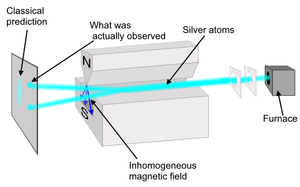
Classical prediction vs. quantum observation

So where does the weirdness come from?
For Buddhists, the freakiness at the smallest scale of physics is the result of our realisation of our mind's involvement in producing reality - that 'the observer is part of the system'.

This mental involvement is actually also apparent on careful examination at our everyday scale of reality, but we don't think about it unless it is painstakingly pointed out, as with King Milinda's chariot. 

However, when we look at the very foundations of reality, the involvement of the observer's mind becomes inescapably obvious.   The act of observation turns potentiality into actuality. 


Observation resolves the question of what the particle actually "is" through a combination of the particle's inherent potentials and the manner in which it is observed.  For a discussion of the experimental details of mind/matter interactions see Quantum Buddhism. 


So how does quantum reality fit with Buddhist Philosophy?
The two aspects of Buddhist philosophy that are relevant to observations at the quantum level are The Four Seals of Dharma and the Three Modes of Existential Dependence.  These teachings were established centuries ago, long before modern physics evolved, and were derived from careful philosophical and meditational analysis of the world.   However their description of quantum reality is remarkably accurate, as they predicted that:

(1)  Particles are not inherently existent. No particle is 'a thing in itself' with a self-contained identity.   An inherently-existent particle would be indestructible, unitary and indivisible.

(2)  Particles are not causeless.

(3)  Particles are not partless, they do not exist as indivisible points.

(4)  Particles are not  'permanent' in the sense of having a unchanging, static identity.

(5)  Particles exist by interaction with the mind of an observer.


...and what we actually see is...

(1)  Particles cannot function as stand-alone entities.  They can only interact with the rest of the universe by exchanging something of themselves - for example gluons or photons. Their properties can only be known by their interactions with other particles, and thus cannot be completely accurately established.


(2)  Particles are brought into existence by energetic events.  The mother of all energetic events was the Big Bang, which brought most of the existing particles into existence.    But natural energetic events such as cosmic rays and beta decay continue to produce particles, and energetic man-made events in particle accelerators produce secondary particles by hadronization  and  creation of particle-antiparticle pairs.


(3)  The tiniest particles (quarks and leptons) do not have parts because they are physically indivisible, but according to the Madhyamika school they have directional parts and so are mentally divisible. If even these smallest forms have parts, it follows that all gross forms that are composed of them also have parts. - Ocean of Nectar p 164

But if, according to Buddhist philosophy, partless particles cannot exist, how can we avoid the infinite regress of small building-blocks being composed of even smaller building-blocks, all the way down for ever?


This infinite regress...


... doesn't happen with the building blocks of matter


The resolution of this apparent contradiction came with discoveries in quantum physics in the early twentieth century. When physicists arrived at the stage where further subdivision was no longer possible, they did indeed find numerically irreducible particles. However these particles are no longer discrete 'things', but are smeared out into a myriad of fuzzy probabilistic 'parts' - a continuum of probabilities distributed in a wave function with spatial 'directional parts'.   
 

And they can even be in two places at once.


(4)  All particles show 'subtle impermanence' - they do not remain in exactly the same state from one moment to the next.  In the nucleus, protons and neutrons are constantly exchanging mesons to hold themselves together.  

In the outer layers of atoms the electrons are never at a single location in their orbitals, but vibrate like a standing wave on a string 


(5) The act of observation turns potentiality into actuality, resolving the question of what the particle actually "is" through a combination of the particle's inherent potentials and the manner in which it is observed.
 

The mathematical equations of quantum physics do not describe actual existence - they predict the potential for existence. Working out the equations of quantum mechanics for a system composed of fundamental particles produces a range of potential locations, values and attributes of the particles which evolve and change with time. But for any system only one of these potential states can become real, and - this is the revolutionary finding of quantum physics - what forces the range of the potentials to assume one value is the act of observation.
 

Matter and energy are not in themselves phenomena, and do not become phenomena until they are observed.  For a discussion of the experimental details see Quantum Buddhism.


Triple slit experiment

From Nature
by Jon Cartwright 
 
'If you ever want to get your head around the riddle that is quantum mechanics, look no further than the double-slit experiment. This shows, with perfect simplicity, how just watching a wave or a particle can change its behaviour. The idea is so unpalatable to physicists that they have spent decades trying to find new ways to test it. The latest such attempt, by physicists in Europe and Canada, used a three-slit version — but quantum mechanics won out again...  Full article


The Penrose-Hameroff Conjecture

From http://philosophy.uwaterloo.ca/MindDict/quantum.html

Penrose's main argumentative line can be summed up as follows:

Part A: Nonalgorithmicity of human conscious thought.

A1) Human thought, at least in some instances, is sound , yet nonalgorithmic (i.e. noncomputational). (Hypothesis based on the Gödel result.)

A2) In these instances, the human thinker is aware of or conscious of the contents of these thoughts.

A3) The only recognized instances of nonalgorithmic processes in the universe are perhaps certain kinds of randomness; e.g. the reduction of the quantum mechanical state vector. (Based on accepted physical theories.)

A4) Randomness is not promising as the source of the nonalgorithmicity needed to account for (1). (Otherwise mathematical understanding would be magical.)

Therefore:
A5) Conscious human thought, at least in some cases, perhaps in all cases, relies on principles which are beyond current physical understanding, though not in principle beyond any (e.g. some future) scientific physical understanding. (Via A1 - A4)


Part B: Inadequacy of Current Physical Theory, and How to Fix It.

B1) There is no current adequate theory concerning the 'collapse' of the quantum mechanical wave function, but an additional theory of quantum gravity might be useful to this end.

B2) A more adequate theory of wave function collapse (a part, perhaps, of a quantum gravity theory) could incorporate nonalgorithmic, yet nonrandom, processes. (Penrose hypothesis.)

B3) The existence of quasicrystals is evidence for some such currently unrecognized, nonalgorithmic physical process.

Therefore:
B4) Future theories of physics, in particular quantum gravity, can be expected to incorporate nonalgorithmic processes. (via B1 - B3)


Part C: Microtubules as the means of harnessing quantum gravity.

C1) Microtubules have properties which make certain quantum mechanical phenomena (e.g. super-radiance) possible. (Hameroff/Penrose hypothesis.)

C2) These nonalgorithmic nonrandom processes will be sufficient, in some sense, to account for A5. (Penrose hypothesis.)

C3) Microtubules play a key role in neuron function.

C4) Neurons play a key role in cognition and consciousness.

C5) Microtubules play a key role in consciousness/cognition (by C3, C4 and transitivity).

Therefore:
C6) Microtubules, because they have one foot in quantum mechanics and the other in conscious thought, provide a window for nonalgorithmicity in human cognition.


Conclusion:
D) Quantum gravity, or something similar,via microtubules, must play a key role in consciousness and cognition.


Comment
I would go along with this as far as B2, but I can't see how any scientific explanation can incorporate nonalgorithmic processes because:
(a) It's impossible to describe how non-algorithmic phenomena work (otherwise they would be algorithmic),   and
(b)  Scientific explanations and models require algorithmic compression to be effective and useful. It's difficult to see how algorithmic compression could apply to a system that was nonalgorithmic.


UPDATE 21Mar-2019
Two contradictory versions of reality can exist at the same time, quantum experiment shows - The Independent 

“...It seems that, in contrast to classical physics, measurement results cannot be considered absolute truth but must be understood relative to the observer who performed the measurement,” said Dr Ringbauer... Full article

Read more at 

Buddhist Philosophy

Quantum Buddhism

Meditation, Downward Causation, Neuroplasticity and the Quantum Zeno Effect

Thursday, 7 March 2013

Intentionality ('Aboutness') and Mental Designation in Buddhism


Nothing but Pixels

Aboutness (intentionality) is something that only minds possess. 

Minds know and perceive objects.   In contrast, words, sentences and symbols can only be about things in a derivative sort of way, in so far as they transmit or evoke a primary aboutness in the mind of the beholder.

Physical things, such as electrical circuits, computer inputs and outputs, do not possess aboutness. As Roger Scruton pointed out recently, the pixels displaying a picture of a woman on a computer monitor are not in themselves about the woman. Only the mind of the viewer is about her. 


Intentionality, aboutness, meaning, semantics and mental designation.

This quality of 'aboutness' is known in Western philosophy as 'intentionality'  - a rather confusing term which has nothing to do with 'intention'. 

Near synonyms for intentionality are 'semantics' and just plain old 'meaning'.

The property of being about something, of having 'an intentional object', is the key feature that distinguishes psychological phenomena from physical phenomena, because physical phenomena lack the ability to generate original intentionality, and can only perform an intentional relationship in a second-hand manner: derived intentionality.

In Buddhist philosophy, intentionality is known as  'mental designation', 'mental imputation', 'mental projection' or 'mental attribution'.

Intentionality plays a much more fundamental role in Buddhism that it does in traditional Western philosophy.  Intentionality, in its role as 'mental designation' is, together with causality and structure, one of the three axiomatic foundations of all phenomena,  and is not reducible to the other two.   


Consequently intentionality, with qualia, is one of the attributes of mind that is not reducible to physical mechanisms.    

'In current artificial intelligence and philosophy of mind intentionality is a controversial subject and sometimes claimed to be something that a machine will never achieve. John Searle argued for this position with the Chinese room thought experiment, according to which no syntactic operations that occurred in a computer would provide it with semantic content.' -  Wiki


The role of intentionality in Western philosophy is weaker than in Buddhism.   Intentionality came comparitively late into Western thought, being first formulated in its modern form by Franz Brentano in the late nineteenth century.  Unlike in Buddhism, intentionality took a long time in the West to be established as a causative aspect of reality, and for much of the twentieth century was dismissed as an epiphenomenon of matter by the dominant philosophies of positivism, behaviorism and materialism: 

'So-called ‘eliminative materialists’ (see Churchland 1989) resolutely opt for the second horn of Quine's dilemma and deny purely and simply the reality of human beliefs and desires. As a consequence of their denial of the reality of beliefs and desires, the eliminative materialists must face the challenge raised by the existence of physical objects whose existence depends on the intentions, beliefs and desires of their designers, i.e., human artifacts.'  -  Stanford Encyclopedia of Philosophy


Mentally indwelling images of real and imagined objects

A mental phenomenon is characterized by reference to a content and/or direction toward an object, which is not necessarily a real 'thing'.  Each mental phenomenon includes something as an object within itself. That object may or may not refer to something in the real world.  That is why these indwelling mental objects ('generic images') are said to be 'inexistent'.  

The word 'inexistent' refers to two attributes of generic images:
(i)  They exist as indwelling images within thoughts.
(ii) The actual physical existence of the objects referred to is irrelevant. They can be either existent, or non-existent, or somewhere in between. 

The mind can grasp generic images of non-existent objects, including objects of its own creation. These objects can be potentially existent, such as a new device in the mind of its inventor, or formerly existent such as the Dodo, or they can be completely non-existent such as a unicorn.

Only minds possess intrinsic intentionality. All symbols, signifiers, signs,  words, computer inputs, outputs and internal states have merely derivative intentionality originating from a mind.


Aesthetics

This property of 'inexistence' - the ability of the mind to construct internal objects before they exist - is the fountainhead of creativity and spiritual transcendence in art.  All great art has a 'spiritual' dimension, even if it is not overtly religious. It is this transcendence of the mundane that we recognise as 'beauty'.


Non-physical Mind

For a discussion of why the mind is a non-physical, fundamental aspect of the universe which is not derived from anything else, see Confronting Materialism and the Delusion of the Mechanistic Mind.

- Sean Robsville


Related Articles


Mind and Mechanism – Buddhism and the Turing Machine

Shared Etymology of 'Meaning' and 'Mind'

Minds, Machines and Meaning

Conceptual Designation 

Mysterians, Mysterianism and the Mystery of the Mind

Qualia - Objective versus Subjective Experience

Objections to Computationalism


Friday, 13 January 2012

The dumbing down of computer literacy and decline of programming in education

All home computers used to be user-programmable

The need for a basic education in computer literacy

As well as career benefits to the individual, and skills benefits to the economy, computer programming (coding) also promotes clear logical thinking and is an instructive source of easily understood analogies for otherwise difficult topics in philosophy, including Buddhist philosophy. 

For example,  the key Buddhist concept of three levels of dependent existence can be understood in terms of algorithms, data structures and semantics, as well as the more traditional view as causality, mereology and mental designation. The use of the Church-Turing-Deutsch  principle to distinguish between the physical and non-physical aspects of the mind follows on from this.

Dumbing down
So it's a matter of concern that as computers become more pervasive, actual computer literacy has declined over the past ten or fifteen years due a process of dumbing down in schools and colleges.   Not only does this impact vocational skills, but lack of computer coding experience among younger people means that computer concepts can no longer be used to illustrate analogies in other fields of study.  Back in the mid-nineties, the growth in familiarity with computer programming was welcomed as a means of illustrating philosophical concepts.

Programming helps with understanding philosophy

Two examples of use of computer analogies in philosophy
In discussing the philosophical concept that conscious experience is a fundamental feature of the universe, irreducible to anything more basic, and that mentality is as fundamental as physicality, Copthorne Macdonald wrote in 1994: 


"The ancients were able to apprehend this perspective intuitively, but had difficulty expressing it clearly in words because they lacked certain key concepts that we now have. The present "information age" or postmodern refinement of the perspective had to wait until these concepts emerged and became part of our cultural vocabulary — concepts like medium and message, carrier and modulation, algorithm and information. It had to wait, for instance, until Claude Shannon (1948) demonstrated that the fuzzy concept of information could have a solid, quantifiable meaning. It had to wait until DNA research in the 1950s showed that organisms and other physical structures are in fact informational structures. It had to wait until the role of algorithms in information processing became clear in the 1960s and 1970s, and until ideas about parallel processing began to emerge in the 1980s."

Similarly, in 1996 Tom Etter discussing quantum mechanics as a branch of mereology, wrote

“Principia Mathematica” by Russell and Whitehead is one of the most famous books of the century, and one of the least read. In his autobiography Russell complains that only four people in the world had ever read his favorite part of the book, which is the part on the theory of relations. Though I am sure that this select company is larger today, it's still not very large. Fortunately for us, the relational ideas from Principia that we really need have found a happy home in the much more accessible language of relational databases.

What I shall present here parallels a much longer paper [Etter, 1996] which I wrote in the language of probability because I assumed that scientists are more at home with probability theory than with mathematical logic. But that was before I encountered relational databases. This happened serendipitously when the little journal I edit acquired Microsoft Access, in the hope of keeping better track of its subscribers. Browsing through the instruction book, I came across the word 'linking,' a crucial word in my long paper, and to my amazement found it had exactly the same meaning as I had given it there! I quickly realized that this harmony extended to many other relational concepts, and that with only a few strokes I could also define the concepts I was using from probability theory. To top it all off, database language is practically the mother tongue of today's young programmers, the fastest growing population on Earth!"

But both articles were written in the mid nineties, before...


The rot set in when coding was abandoned in favor of applications
Learning boring applications has replaced the mental challenge of coding.
 

The basic (or BASIC) problem is that young people are no longer taught to program computers, and indeed have few facilities to do so. Children are 'bored out of their minds being taught how to use Word or Excel by bored teachers'  instead of being taught how to program.  

BASIC or nothing


The problem was first described in 2006 by David Brin in his excellent article 'Why Johnny can’t code': 

'BASIC used to be on every computer a child touched -- but today there's no easy way for kids to get hooked on programming.  For three years — ever since my son Ben was in fifth grade — he and I have engaged in a quixotic but determined quest: We’ve searched for a simple and straightforward way to get the introductory programming language BASIC to run on either my Mac or my PC.


Why on Earth would we want to do that, in an era of glossy animation-rendering engines, game-design ogres and sophisticated avatar worlds? Because if you want to give young students a grounding in how computers actually work, there’s still nothing better than a little experience at line-by-line programming.
Only, quietly and without fanfare, or even any comment or notice by software pundits, we have drifted into a situation where almost none of the millions of personal computers in America offers a line-programming language simple enough for kids to pick up fast. Not even the one that was a software lingua franca on nearly all machines, only a decade or so ago. And that is not only a problem for Ben and me; it is a problem for our nation and civilization... Read more.


British government to re-introduce programing for kids
The results of a decade of dumbing down have also recently been noticed by the British educational establishment (better late than never).


Back to the future?

School Information and Computer Technology to be replaced by computer science programme
"The current information and communications technology (ICT) curriculum in England's schools is a "mess" and must be radically revamped, the education secretary has announced.

From September it will be replaced by a flexible curriculum in computer science and programming, designed with the help of universities and industry.Michael Gove called the current ICT curriculum "demotivating and dull". He will begin a consultation next week on the new computing curriculum.

He said this would create young people "able to work at the forefront of technological change".

The education secretary said the inadequate grounding in computing offered by the current curriculum was in danger of damaging Britain's economic prospects. He called for a revival of the legacy of British computer pioneer Alan Turing whose work in the 1930s laid the foundation of the modern computing industry.

"Imagine the dramatic change which could be possible in just a few years, once we remove the roadblock of the existing ICT curriculum. Instead of children bored out of their minds being taught how to use Word or Excel by bored teachers, we could have 11-year-olds able to write simple 2D computer animations," he said.

Computer games entrepreneur Ian Livingstone, an adviser to Mr Gove, envisages a new curriculum that could have 16-year-olds creating their own apps for smartphones and 18-year-olds able to write their own simple programming language.

'Slaves to the interface'

Mr Livingstone, co-author of last year's Next Gen report which highlighted the poor quality of computer teaching in schools, told BBC news: "The current lessons are essentially irrelevant to today's generation of children who can learn PowerPoint in a week.It's a travesty given our heritage as the most creative nation in the world. Children are being forced to learn how to use applications, rather than to make them. They are becoming slaves to the user interface and are totally bored by it," he said....


In America, the problem is also at last being officially recognised:

New York Mayor Michael Bloomberg takes coding course   
The mayor is joining more than 180,000 people currently taking part in Code Year, a campaign to encourage more people to programme.

"My New Year's resolution is to learn to code with Codecademy in 2012!" he wrote on Twitter. Participants in the course receive an interactive lesson each week, via email. The campaign promises that participants will be "building apps and websites before you know it"...

It is not clear what Mr Bloomberg hopes to do with his new computer skills, but his decision to learn comes at a time of renewed interest in encouraging people to programme. In October, the Next Gen report into the teaching of computing in UK schools was published. Co-author Alex Hope told the BBC that coding should be "the new Latin".


Back in the dim and distant past, Latin, with its rigorous grammar, was taught as a method of developing clarity of thought and expression.   The mental discipline of programming has similar general benefits that extend beyond vocational and technical skills. 


RASPBERRY PI
A basic education in computer literacy

Raspberry Pi to bring low-cost coding to every child
Can a £15 ($25) computer solve the programming gap?
BBC Video about new low-cost programming gadget


'The idea behind a tiny and cheap computer for kids came in 2006, when Eben Upton was lecturing and working in admissions at Cambridge University. Eben had noticed a distinct drop in the skills levels of the A Level students applying to read Computer Science in each academic year when he came to interview them. From a situation in the 1990s where most of the kids applying were coming to interview as hobbyist programmers, the landscape in the 2000s was very different; a typical applicant now had experience only with web design, and sometimes not even with that. Fewer people were applying to the course every year. Something had changed the way kids were interacting with computers.

Eben and colleagues from the university like Rob Mullins and Alan Mycroft (both now trustees of the Raspberry Pi Foundation) batted around ideas about what had happened in schools to cause this change. A number of problems were identified: the colonisation of the ICT curriculum with lessons on using Word and Excel, or writing webpages; the end of the dot-com boom; and the rise of the home PC and games console to replace the Amigas, BBC Micros, Spectrum ZX and Commodore 64 machines that people of an earlier generation learned to program on.

There isn’t much any small group of people can do to address problems like an inadequate school curriculum or the end of a financial bubble. But we felt that we could try to do something about the situation where computers had become so expensive and arcane that programming experimentation on them had to be forbidden by parents; and to find a platform that, like those old home computers, could boot into a programming environment.
Over the next few years, Eben, having left the university for industry, worked on building prototypes of what has now become the Raspberry Pi in his spare time.

Raspberry Pi


By 2008, processors designed for mobile devices were becoming more affordable, and powerful enough to provide excellent multimedia (a Raspberry Pi can play Blu-Ray-quality video), a feature we felt makes the board desirable to kids who aren’t initially interested in a raw programming device. The project started to look very realisable. Eben came together with a group of friends and old colleagues with a wide-ranging group of skills, some of whom were already wrestling with the problem of what to do about producing new young programmers. These people became the Raspberry Pi board of trustees: David Braben, a star game designer and Cambridgeshire entrepreneur with a book of contacts as long as your arm; Jack Lang, a local academic and business angel who worked on the original BBC Micro project; Pete Lomas, MD of a hardware design and manufacture company where our earliest boards have been designed and built; and Professor Alan Mycroft and Dr Rob Mullins from the Cambridge University Computer Lab, who have provided a lot of the educational direction of the project.    More 


+++++


Raspberry Pi update 29-FEB-2012

"...The first thousands on release today were funded largely out of the pockets of Dr Upton and his five fellow foundation scientists.

Now they will receive royalties on every Pi sold, and will be able to focus on their main concern - improving what is widely seen as the woeful state of Britain's computer science curriculum.

That was underlined last summer by American Google chairman Eric Schmidt, who said that, as the country that invented the computer, the UK was "throwing away its great computer heritage" by failing to teach programming in schools.

Robert Mullins, Eben Upton, David Braben The Pi has changed in development, as the members of Raspberry Pi Foundation demonstrate.

"I was flabbergasted to learn that today computer science isn't even taught as standard in UK schools," he said.

"Your IT curriculum focuses on teaching how to use software, but gives no insight into how it's made."

Dr Upton believes the Pi could provide part of the solution: "We just want to get kids programming. The goal here is to increase the number of children to apply to university to do computer science and to increase the range of things they know how to do when they arrive."

Here at Chesterton Community College Mr Schmidt's criticism might be seen as unfair, because ICT head Paul Wilson is not a typical example of an information and communications technology teacher.

Unlike many of his colleagues in the field he knows how to code, and once did it for a living. He also runs a popular programming club after school.
Continue reading the main story

But even he admits the current ICT school curriculum means most of his lesson time is spent in learning how to use software rather than teaching his pupils how to write the code that makes that software work.

He estimates just a tiny fraction of the students he teaches will go on to study computer science at a higher level.

His hunch is backed up by research carried out by the Royal Society which last month pinpointed a 60% decline in the number of British students achieving an A-level in computing since 2003...."

- Sean Robsville